
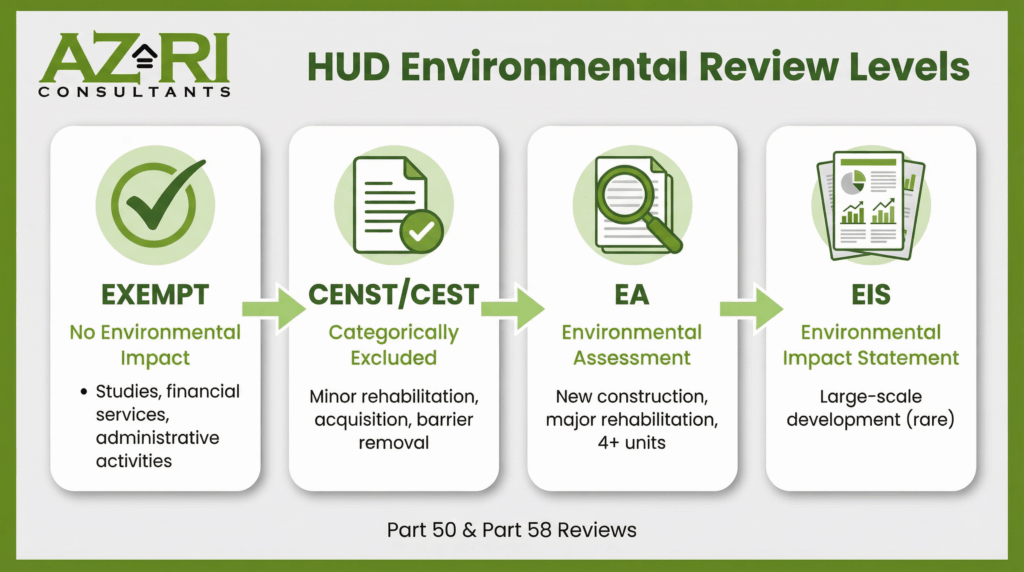
HUD Environmental Reviews are not one-size-fits-all. The scope and complexity of the review depend on the project’s activities, size, and potential environmental impact. Understanding the different levels of review is the first step to accurately planning your project’s timeline and budget.
All HUD-funded projects must be reviewed for compliance with the National Environmental Policy Act (NEPA) and related federal environmental laws. This review falls into one of four main categories, with slightly different terminology for Part 50 and Part 58 reviews.
1. Exempt Activities
Certain activities are considered “Exempt” from NEPA review because they have been determined to have no environmental impact. These are very limited and typically include:
•Environmental and other studies
•Information and financial services
•Administrative and management activities
2. Categorically Excluded
This is the most common level of review for HUD-funded projects. These activities are categorically excluded from NEPA but require a compliance review for the federal environmental laws and authorities. The terminology differs slightly between Part 50 and Part 58:
Part 58: Categorically Excluded Subject to §58.5 (CEST)
For Part 58 reviews, CEST activities typically involve minor physical work, such as:
•Rehabilitation of buildings that does not significantly change the use, size, or capacity
•Acquisition or leasing of existing properties
•Removal of architectural barriers
Part 50: Categorically Excluded Subject to §50.4 (CEST)
For Part 50 reviews, CEST activities are similar to Part 58 but are reviewed directly by HUD. These often include FHA-insured multifamily projects involving minor rehabilitation or acquisition.
3. Environmental Assessment (EA)
An Environmental Assessment is required for projects that are not Exempt or Categorically Excluded. This includes most new construction, major rehabilitation, and projects that significantly change the use or size of a property. Common triggers for an EA include:
•New construction of four or more housing units
•Major rehabilitation that increases residential density by more than 20%
•Projects that involve the demolition and reconstruction of a building
An EA is a more detailed analysis that evaluates the project’s potential impacts on a wider range of environmental factors, including land development, socioeconomic conditions, community facilities, and natural features. This applies to both Part 50 and Part 58 reviews.
4. Environmental Impact Statement (EIS)
An EIS is required for projects that are determined to have a significant impact on the human environment. These are rare for HUD projects and typically involve large-scale development with major environmental implications.
Determining the Correct Level of Review
Correctly identifying your project’s level of review is critical. An incorrect determination can lead to significant delays, requests for additional information from HUD, or the need to redo the entire environmental review.
Not sure which level of review applies to your project? AZ-RI Consultants has extensive experience with both Part 50 and Part 58 reviews and can help you make an accurate determination, ensuring your environmental review is completed efficiently and correctly. Contact us today to get started.